



Sling Platform vs Fivetran — The Honest Comparison
Last updated: July 2026
Fivetran built the modern ELT category. It is well-engineered, widely deployed, and has a genuinely large connector catalog. It is also one of the loudest sources of bill shock in data engineering Slack channels.
Both Sling Platform and Fivetran are web-application-driven ELT platforms — you manage pipelines through a dashboard, set schedules, and monitor runs. This page compares them directly: where Fivetran wins, where Sling wins, and which one you should pick based on what you’re actually trying to do.
TL;DR
| Sling Platform | Fivetran | |
|---|---|---|
| Pricing model | Flat ($0 / $99 / $249/mo) | Per-row (MAR metered) |
| Self-hosted | ✅ Self-hosted agents in your infra | ❌ Managed cloud only |
| Data through vendor | ❌ Never — agent runs in your VPC | ✅ Always |
| Open source engine | ✅ Core engine is GPLv3 OSS | ❌ Closed source |
| CLI / YAML config | ✅ YAML-first, git-compatible | ⚠️ Dashboard-first, Terraform wrapper |
| Schema drift handling | ✅ add_new_columns + adjust_column_type | ✅ Automatic |
| Custom REST sources | ✅ 90+ built-in + api-spec YAML | ⚠️ Lambda-style SDK |
| Pre-built SaaS connectors | 90+ REST APIs + 40+ DB/FS | 750+ sources |
| Account required to start | ✅ Yes (free tier available) | ✅ Yes |
Where Fivetran wins
SaaS API connector breadth
Fivetran advertises 750+ sources. Salesforce, NetSuite, Workday, Marketo, HubSpot, Zendesk, and hundreds more. Sling covers the major databases and 90+ REST APIs today. The api-spec format lets you add any REST source — but you write the YAML yourself rather than picking from a managed registry.
If your stack is 15+ long-tail SaaS APIs that Sling hasn’t yet built a spec for, Fivetran’s catalog wins. Full stop.
Enterprise procurement readiness
SOC 2, HIPAA, BAAs, named CSMs, SLAs printed on paper — Fivetran has all of it. If your procurement team needs a vendor security packet in two weeks, Fivetran can deliver. Sling’s security posture is different: since data never leaves your infrastructure, the surface area is smaller, but the paperwork trail is shorter.
Fully managed infrastructure
Fivetran runs everything for you. There’s no agent to deploy, no container to maintain, and no infra bill tied to sync operations. If your data team has no infrastructure engineering capacity, that simplicity is real value.
Where Sling wins
1. Pricing that doesn’t punish growth
Fivetran charges on Monthly Active Rows (MAR) — every row that moves through a connector counts against the meter. The complaints are easy to find:
“We went from $600/mo to $6,000/mo over 18 months as our data grew. The connector counts didn’t change — just the row volume.” — HN thread on “Fivetran pricing alternatives” (paraphrased from multiple public comments)
Sling Platform charges flat:
- Free tier — limited runs, no credit card required
- Standard — $99/mo flat
- Advanced — $249/mo flat
A billion-row sync costs the same as a million-row sync. No surprises at the end of the month.
2. Your data never leaves your infrastructure
Fivetran is a managed cloud service. Every row you sync flows through Fivetran’s infrastructure before landing in your warehouse. For finance, healthcare, government, or EU-GDPR-strict organizations, that is often a hard blocker — not a preference.
Sling Platform uses a self-hosted agent model. You run the agent inside your own Docker container or Kubernetes pod, in your own VPC. The control plane orchestrates jobs and stores metadata — your rows never flow through it.
# replication.yaml — runs entirely in your environment
source: MY_POSTGRES
target: MY_SNOWFLAKE

defaults:
  mode: incremental
  primary_key: id
  update_key: updated_at

streams:
  public.orders:
  public.customers:
  public.products:
Data residency, compliance auditability, lower egress costs — you’re on your own bandwidth and compute.
3. YAML-first configuration — not a dashboard black box
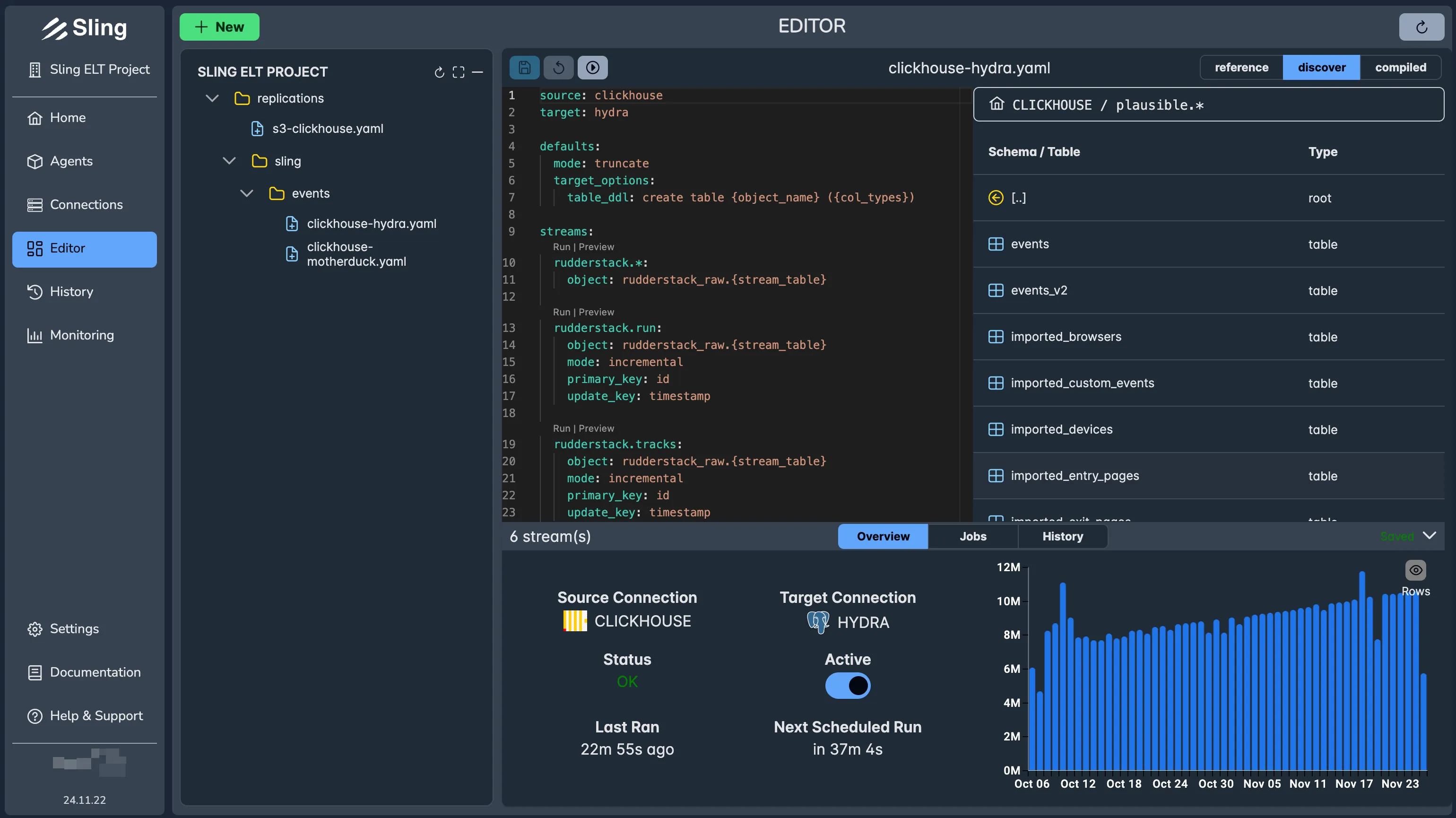
A Sling replication is a 12-line YAML file that lives in your git repo. You diff it, review it, roll it back, and CI/CD it. Fivetran connectors live in their dashboard. They have a Terraform provider, but it wraps their API rather than being a first-class IaC contract — and most teams don’t use it.
Sling’s YAML also gives you explicit control over behavior that Fivetran abstracts away: column type overrides, pre/post hooks, SQL transforms, custom SQL sources, per-stream primary key configuration. The editor in Sling Platform keeps all of that in one view — YAML config, run history, and connection status — without hiding it behind a settings API.
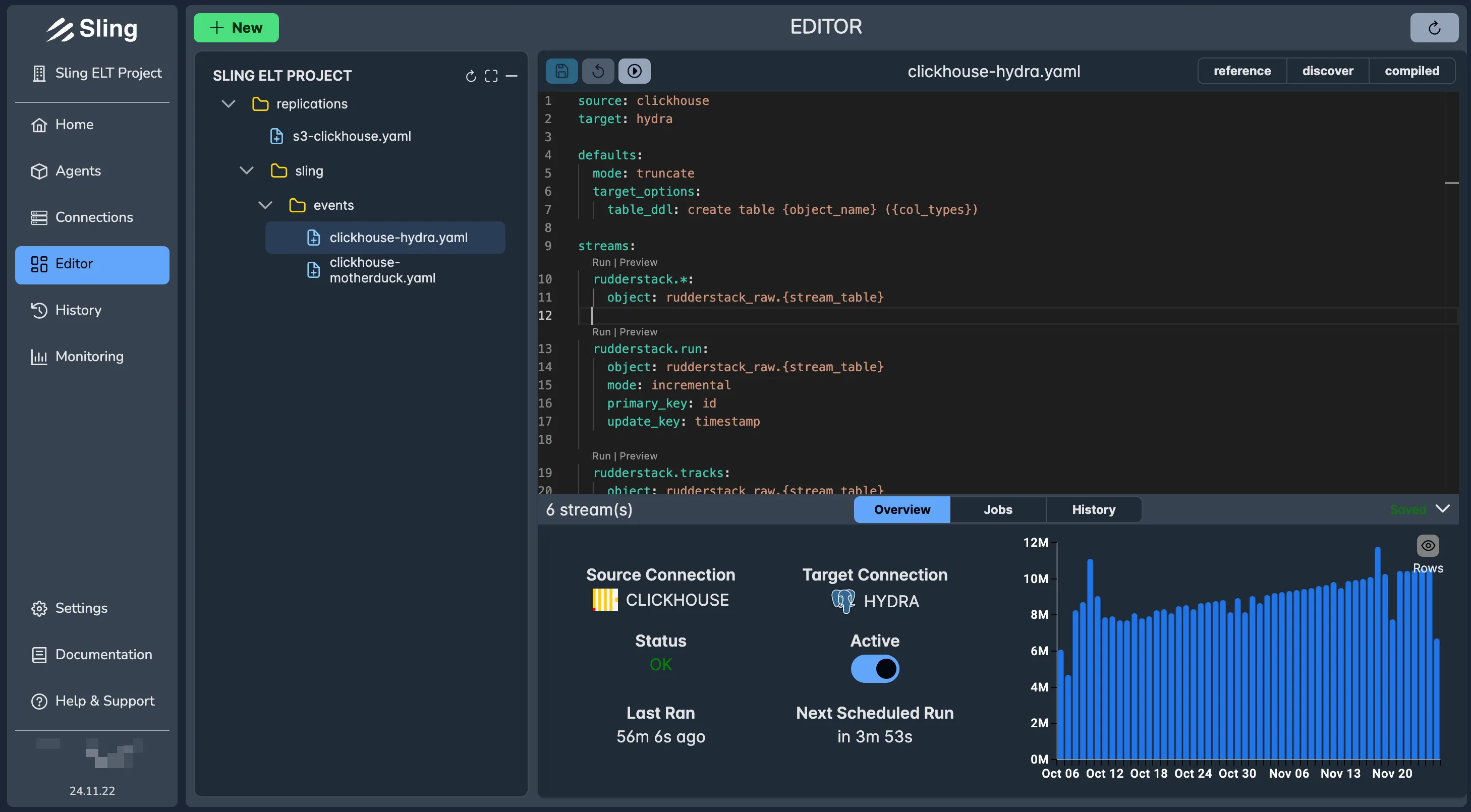
If an engineer leaves your data team and took the mental model of your pipelines with them, Sling’s YAML is the audit trail. Fivetran’s dashboard is not.
4. Schema drift handling — without the black box
Sling Platform handles schema drift. The add_new_columns target option automatically adds new source columns to the destination table when detected. The adjust_column_type option handles type evolution. Both are opt-in per stream, giving you explicit control over which tables get automated drift handling and which are locked.
The difference from Fivetran: Sling’s behavior is declared in your YAML and visible in your git history. Fivetran’s schema drift handling is automatic but opaque — when a column silently migrates, the audit trail is a Fivetran UI log rather than a git commit.
5. Open source engine, auditable code
The Sling execution engine is GPLv3-licensed and open source on GitHub. You can read the connector code, fork it, contribute to it, or audit it. When a sync produces an unexpected result, you can trace it to a line of Go rather than opening a support ticket.
Fivetran is a closed black box. The connector logic is not visible. If you need to understand why a row landed a certain way, you’re reading logs and opening support tickets.
When to choose Fivetran
- More than half your sources are long-tail SaaS APIs (NetSuite, Workday, Salesforce CPQ, Marketo) that change schema frequently.
- Your data team does not want to manage any infrastructure — not even a Docker container.
- You’re in an enterprise procurement cycle and need vendor security paperwork in weeks.
- The pricing math works for your row volumes (i.e., you’re not at the scale where MAR billing becomes painful).
When to choose Sling Platform
- You’re primarily moving data between databases, data lakes, and file systems — not dozens of obscure SaaS APIs.
- You need data residency — your rows must not traverse a vendor network.
- You want fixed, predictable costs regardless of data volume growth.
- You’re a data engineer comfortable with a CLI and YAML and want config-as-code from day one.
- You need self-hosted or air-gapped execution — healthcare, finance, government, or secure environments.
- You want the core engine GPLv3-licensed so you can audit and fork the connector code.
- You want EL and T from independent vendors — composable rather than bundled. Sling moves data; you choose your transform layer (dbt, SQLMesh, Spark, or nothing). No single vendor controls both meters.
The Fivetran + dbt Labs merger
In October 2025, Fivetran and dbt Labs announced an all-stock merger. The deal closed in June 2026. George Fraser (Fivetran) remains CEO; Tristan Handy (dbt) becomes President. Fivetran also announced its acquisition of Census (reverse ETL) in May 2025 — folded into the platform as Fivetran Activations in February 2026 — and acquired Tobiko/SQLMesh in September 2025 (donated to the Linux Foundation in March 2026).
If you’re an existing Fivetran customer, three things are worth watching.
The billing picture gets more complex. Fivetran’s MAR model is already the most common complaint about the product on HN and data Slack channels. dbt Cloud charges separately per seat or per model run. Under one vendor, you now have two consumption-based meters scaling independently. Whether the merger changes either pricing model is not public; what’s documented is that both exist.
The vendor concentration is real. Fivetran now owns the EL layer (Fivetran connectors), the activation layer (Census), and the transformation layer (dbt Labs). They also own SQLMesh via the Tobiko acquisition. If your current stack uses Fivetran for EL, dbt Core for T, and other tools for activation, you are now building on infrastructure where one vendor controls every layer — and whose roadmap decisions may reflect bundling incentives over individual tool quality.
The “open” language is ambiguous. The merged entity is using “open data infrastructure” in its positioning. dbt Core is Apache 2.0; dbt Cloud is closed-source SaaS. Fivetran has no open-source offering. Sling’s core binary is GPLv3 and the connector code is on GitHub.
None of this means you should leave Fivetran. It means a vendor review is reasonable if you’re coming up on renewal.
Switching from Fivetran to Sling
Each Fivetran connector maps to a Sling source connection plus a replication YAML. The migration approach:
- Identify your highest-MAR connectors. Those are where the monthly cost delta is largest. Start there.
- Set up the Sling connection for that source. Most DB and file-system connectors need only a connection string — see the docs.
- Write a replication YAML mirroring your Fivetran sync settings (tables, mode, primary keys). Sling’s
full-refreshandincrementalmodes cover the common cases. - Run a parallel sync for one week. Compare row counts between Fivetran’s output and Sling’s. Fix any edge cases.
- Cut over — point downstream consumers at the Sling-written tables and cancel the Fivetran connector.
The process is connector-by-connector. You don’t have to move everything at once.
Related guides
- Sling vs Fivetran: what 100M rows a month actually costs — the pricing model built out with a runnable cost script you can plug your own MAR into
- Export PostgreSQL to Snowflake — a full replication walkthrough for the most common warehouse-load path
- Replicate Databricks Lakebase to Snowflake — the same pattern against Databricks’ serverless Postgres, with incremental and type-mapping detail
Frequently asked questions
Is Sling a free Fivetran alternative?
Sling Platform has a free tier with limited runs. The Standard plan is $99/mo and Advanced is $249/mo. Both charge a flat monthly fee regardless of row volume, unlike Fivetran which meters by Monthly Active Rows.
Does Sling support as many connectors as Fivetran?
Fivetran advertises 750+ sources. Sling covers 40+ databases, file systems, and 90+ REST APIs. If your stack is primarily databases and file systems rather than long-tail SaaS APIs, Sling covers the common cases, and you can add any REST API via Sling’s api-spec YAML format.
Can I self-host Sling like I can with open-source alternatives?
Yes. Sling Platform uses a self-hosted agent model. You run the agent inside your own Docker container or Kubernetes pod in your own VPC. Your data never flows through Sling’s infrastructure. The control plane orchestrates the jobs but never sees your rows.
How does Sling pricing compare to Fivetran?
Fivetran charges per Monthly Active Row (MAR), which scales with data volume. Sling Platform charges flat: $0 / $99 / $249 per month. A billion-row sync costs the same as a million-row sync, so there are no surprises at the end of the month.
Did the Fivetran and dbt Labs merger change the pricing?
The all-stock merger closed in June 2026, but neither company has published a change to how MAR or dbt Cloud seats are billed. What is documented is that both consumption meters still exist, so a combined stack now has two usage-based costs scaling independently.
How hard is it to migrate a Fivetran connector to Sling?
Each Fivetran connector maps to a Sling source connection plus a replication YAML that mirrors the sync settings. Most teams start with their highest-MAR connectors, run a parallel sync for a week to compare row counts, then cut downstream consumers over to the Sling-written tables one connector at a time.
Try Sling Platform
Start free → — free tier available, no credit card required.
View pricing → — Standard $99/mo, Advanced $249/mo. Flat rate, no per-row metering.
Questions? Join the Sling Discord → — the founder is there every day.